How it works#
This page walks a request through the gatehouse in the order the gateway handles it, and shows where Drawbridge sits in the Wayne State application stack.
Where it fits in the stack#
Drawbridge is one part of the Wayne State application stack: one contract, several paths that agree, accessibility as a gate, and decisions written down. WELD is the Laravel starter app with the rest of it already set up.
| Part | Job |
|---|---|
| WayneUI | the interface layer (project 0 of the stack) |
| CREED | the shared rules and policy format |
| PROCTOR | checks an app against the version policy |
| SESAME | sign-in inside the app; its gateway driver verifies what Drawbridge signs |
| HELMET | security headers and CSP reporting |
| Sourdough | the starter that keeps the stack fed |
| Squire | the Citadel deploy kit; the layer that serves this repo's front page is one |
| Parity | Citadel on your computer: its PHP image, its proxy and MySQL 5.6, so an app that works here works on Citadel |
| Preflight | the shared CI components |
| Pinstripe | the coding standard presets (Pint, PHPStan, ESLint, Rector) |
| Booster | upgrades an app's PHP, Laravel and front end, one hop at a time |
| Rollcall | the fleet census: which apps run what, and how close each is to end of life |
| Drawbridge | the one OpenID Connect front door for the Citadel |
| ADVISOR | the read-only MCP server that answers a coding agent's stack questions |
| WELD | the Laravel starter app with the rest of the stack already set up |
The request path#
browser --> Apache httpd (Drawbridge) --> app container
              |  mod_auth_openidc : OpenID Connect client (Entra ID), one session cookie per app host
              |  mod_lua          : strips identity headers on every request, before anything else
              |  mod_rewrite      : asks the PHP signer for an assertion (prg: map)
              |  mod_proxy        : forwards to the app
              `- PHP component    : validates the config, renders the Apache config, signs assertions (ES256)
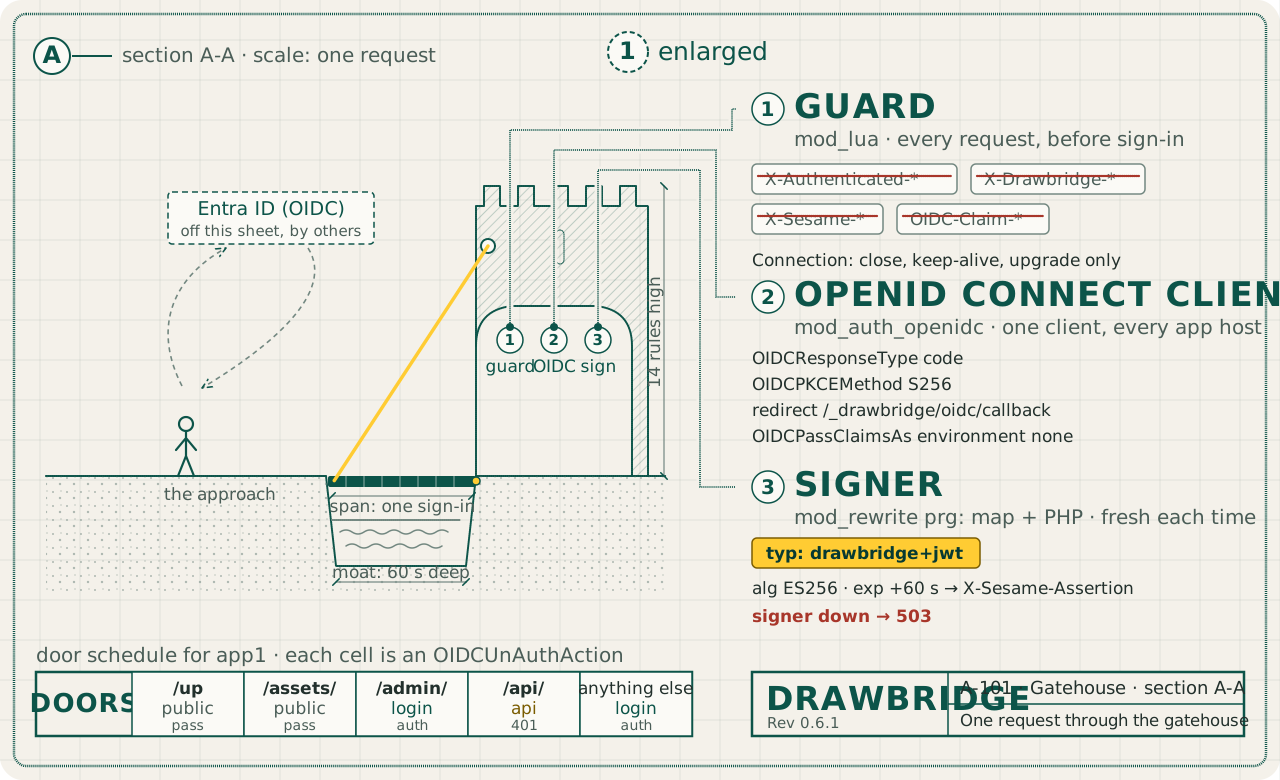
Detail 1, enlarged: the three rooms of the passage, labeled from the source. The drawing inks itself in, and holds still if you have asked your system for less motion.
- A request for a protected path without a session goes to Entra to sign in (authorization code flow with PKCE) and comes back. For an api path it gets a plain 401, so a script never receives an HTML login page. A public path passes through with no identity attached.
- mod_auth_openidc checks the ID token (signature, issuer, audience, nonce, expiry) and keeps the session. The claims reach the gateway in the request environment only, never as headers, and no Entra token is passed to an app.
- The assertion is a compact JWT with
typ: drawbridge+jwtand akid. Claims:iss(Drawbridge, never Entra),aud(the app's host),sub(the configured user claim,accessidin the example config andpreferred_usernameif unset),iat,nbf,exp(60 seconds by default),jti;auth_time,amrandacrswhen the ID token carries them;email,nameandaffiliationswhen configured; and anyextra_claims(for examplewsu_roles). A new one is signed for every request, and only from an ID token whoseissis the configured provider. - If the signer cannot sign, the answer is 503 and the request does not reach the app. There is no unsigned mode: an app gets the signed assertion or nothing (the header modes were removed for 1.0).